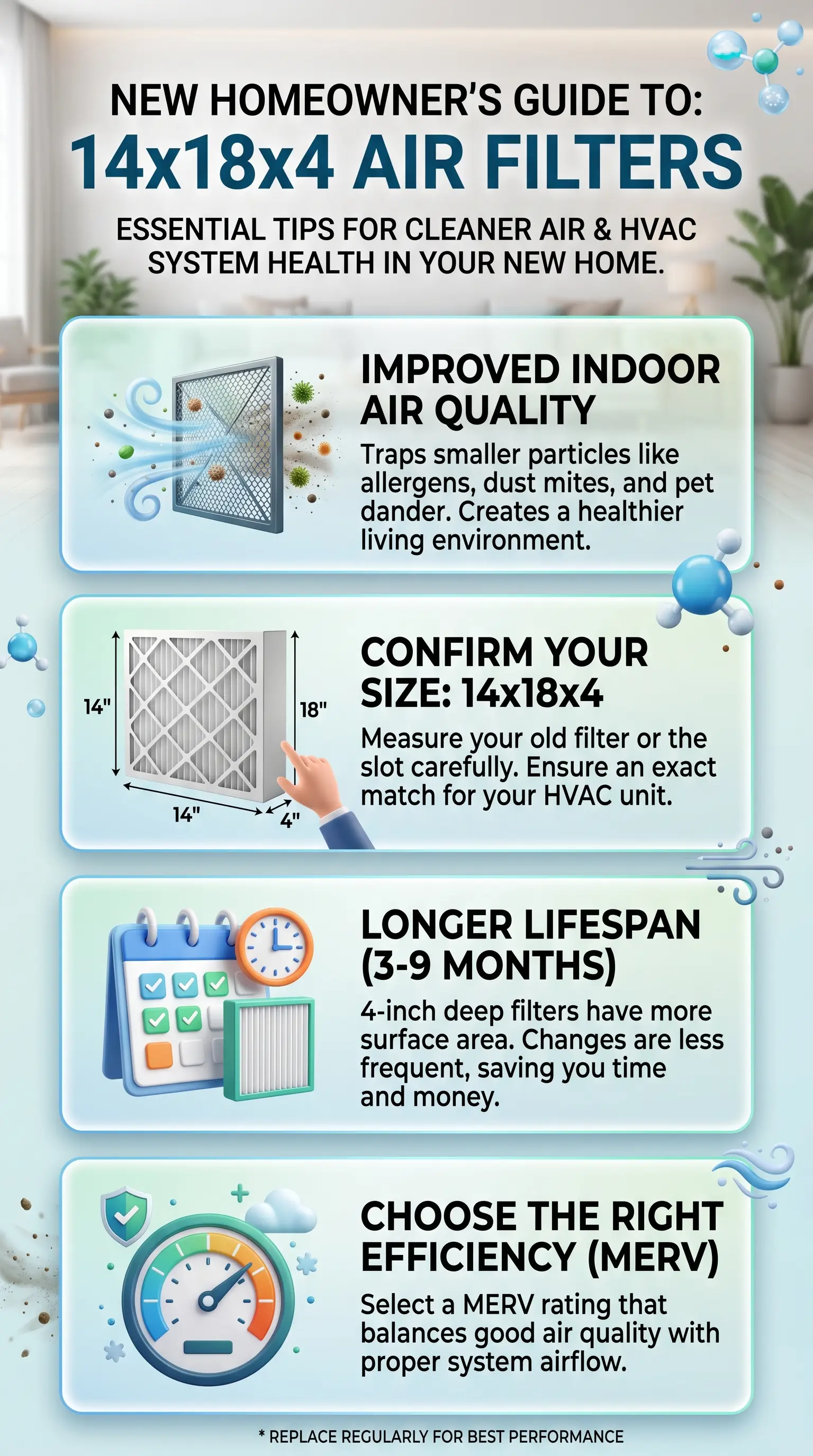
When did the previous owner last change that 14x18x4 filter? If you can't answer, your new HVAC system has been breathing someone else's dust since the day you got the keys. We see this in nearly every Palm Beach County home we walk through during a first-year tune-up, and it sits at the top of the easy-fix list.
A 14x18x4 isn't a generic furnace filter. It's a 4-inch media filter, which means more pleated surface area and longer life than the thin panels most homes use, with less restriction on your blower motor. This guide covers what we wish every new homeowner knew the day they got the keys: how to confirm the size, pick the right MERV rating, install it the right way, and set a replacement schedule that survives a Florida summer.
We're an air-obsessed company, and we live in this climate ourselves. Let's get yours dialed in.
TL;DR Quick Answers
Size: 14 by 18 by 4 inches nominal. Actual measurements run slightly smaller (around 13.5 by 17.5 by 3.75).
Best general MERV: 11.
Best allergy MERV: 13. Verify the system can handle it first.
Replacement frequency in West Palm Beach: every 4 to 6 months.
Most common mistake: installing the airflow arrow backwards.
Yearly cost: usually lower than 1-inch filters thanks to longer service life.
Pair with: an annual HVAC tune-up so the system runs longer with fewer summer breakdowns.
Top Takeaways
Nominal size is 14 by 18 by 4 inches. Actual measurements run slightly smaller so the filter slides in without binding.
A 4-inch depth gives you roughly four times the pleated surface area of a 1-inch filter. The result is longer life and easier airflow.
Confirm the size by reading the existing filter or measuring the slot. Don't trust what the previous owner left behind.
MERV 11 fits most homes. MERV 13 is the better choice for allergy households if the system can handle it.
Replace every 4 to 6 months in South Florida. Drop to 3 or 4 months with pets or continuous AC use.
The airflow arrow must point toward the blower. Backwards installation is the single most common mistake we see.
Pair filter changes with an annual HVAC tune-up. Equipment lasts longer and breaks down less in summer.
What a 14x18x4 Air Filter Actually Is
"14x18x4" is the nominal size: 14 inches tall, 18 inches wide, 4 inches deep. The actual measurements run a touch smaller (typically 13.5 by 17.5 by 3.75) so the filter slides into the cabinet without binding. The depth is what makes this filter special. Compared to a 1-inch panel, you get roughly four times the pleated media surface area, which translates to cleaner air and less pressure drop on your blower.
You'll find this size in select Carrier, Trane, Honeywell, and Lennox whole-home filtration cabinets, usually mounted at the air handler return rather than at a wall grille. The job of an air filter is simple: trap dust, pollen, pet dander, mold spores, and finer particles before they reach your equipment or your lungs.
This 4-inch media-filter family also includes nearby sizes worth knowing. If a previous owner switched cabinets at some point, you may actually be looking at a 16x20x4 size guide or a 20x25x4 furnace resource instead. The principles in this guide work across the whole 4-inch depth family.
If you want to see what's available right now, you can browse premium 14x18x4 air filters from Filterbuy in MERV 8, 11, and 13 ratings, made-to-order in the United States and shipped to your door.
Confirming the Size Before You Buy
Don't trust the previous owner. Pull the existing filter and read the printed nominal size on the cardboard frame. That's your most reliable source. If the slot is empty, measure it yourself in inches and round up to the nearest nominal size. The owner's manual or the air handler's data plate will also list the right size.
Don't be surprised if the actual size isn't what you expected. A lot of newer Florida builds use slimmer cabinet filters. Check this 10x24x1 filter guide for a common smaller size, or look at 20x25x2 filter info and 20x23x1 size details if your home uses one of those. The rule is the same. Confirm the printed nominal size first, then buy.
In our experience, mis-sized filters are the number-one reason a perfectly good HVAC system underperforms in a newly purchased home. Air bypasses the filter, dirt builds up on the evaporator coil, and the system slowly chokes itself.
Picking the Right MERV Rating
MERV stands for Minimum Efficiency Reporting Value. The residential scale runs 1 to 16. Higher means finer filtration, but it also means more airflow restriction, and not every system handles that well. For a 14x18x4 in a typical Palm Beach County home, choose between three ratings.
MERV 8 catches dust, pollen, and lint. Solid baseline for homes without pets or allergy issues.
MERV 11 adds pet dander and mold spores to that list. This is the rating we recommend most often.
MERV 13 goes further: bacteria, smoke, and virus-carrier particles. Best for allergy households, but verify your system can move enough air through the denser media.
Some big-box stores use a different rating system called FPR. The two scales are related, but the numbers don't match up cleanly. This FPR to MERV conversion explainer is the clearest reference we've found. For households dealing with allergies, an allergen defense option in the 14x18x4 size at MERV 13 is a popular pick when the air handler can move enough air through the denser media.
Higher isn't always better. Older systems struggle to push enough air through MERV 13 media. The result is reduced cooling capacity and a stressed blower. When in doubt, go with MERV 11.
How Often to Replace a 14x18x4 Filter
A 4-inch media filter typically lasts 6 to 12 months. That's a much longer interval than the 1 to 3 months a 1-inch filter gives you. South Florida changes the math, though. Year-round AC runtime, coastal humidity, and seasonal pollen waves all shorten the window. Plan on these intervals:
Every 4 to 6 months for most West Palm Beach homes.
Every 3 to 4 months if you have indoor pets, recent renovation dust, or run AC constantly.
Every 6 to 9 months for snowbird or part-time residences.
Replacement intervals shift dramatically with filter depth. Look at a 14x30x1 change schedule or this breakdown of 20x25x2 change frequency and you'll see thinner filters get swapped two to four times more often. Some homeowners get tired of disposables entirely and look at reusable filter options in those thinner sizes. The depth and trapping efficiency of a quality 14x18x4 is still hard to beat.
Write the install date on the frame with a permanent marker. Simple trick, works every time.
Step-by-Step Replacement
Power down the whole HVAC system at the thermostat. Not just "fan off."
Locate the filter cabinet. It's usually at the air handler or behind a return grille.
Slide out the old filter and inspect it for heavy dust, mold growth, or moisture damage.
Find the airflow arrow on the new filter. It must point toward the blower, away from the return.
Slide the new 14x18x4 into the cabinet, secure the access panel, and restore power.
Write the install date on the frame and set a calendar reminder for your next swap.
The arrow direction is the single most common mistake we see. A backwards filter loses 10 to 15 percent of its rated efficiency on day one and lets debris pass through the unsupported side of the pleats.
If allergies or asthma symptoms stick around after the filter upgrade, whole-home air treatment is the next layer. South Florida homeowners often pair a high-MERV 14x18x4 with professional ionizer installation services for added pathogen and VOC reduction.
Why This Matters Especially in West Palm Beach
Florida HVAC systems work harder than their northern cousins. Year-round cooling load means more air cycles through your filter every month. Coastal humidity and salt particulate stress the filter media in ways drier climates don't. Pollen seasons and afternoon thunderstorm cycles create indoor allergen spikes that a tired filter can't handle. A correctly sized, fresh 14x18x4 reduces strain on the blower motor and protects the evaporator coil, which extends the life of a system most homeowners would rather not replace early.
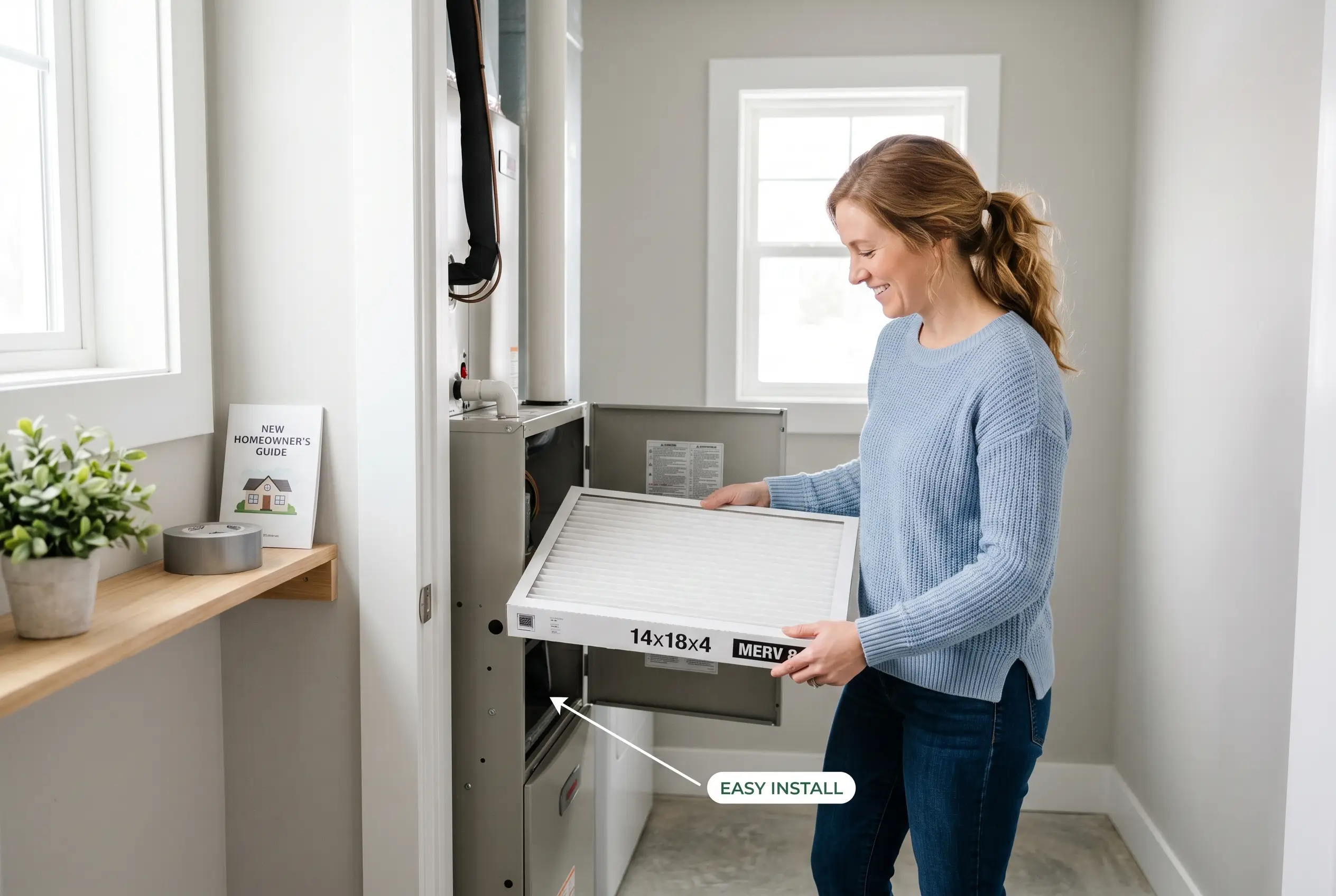
After more than a decade walking through HVAC closets across Palm Beach County, I can tell you the single biggest predictor of a long-living AC system isn't the brand on the cabinet. It's whether the homeowner sets a six-month reminder for the 14x18x4 and actually keeps it.
7 Essential Resources
Verified non-commercial sources we lean on when we want a second opinion. Each one sits on a unique domain. All are government, public health, or research.
1. EPA Indoor Air Quality (IAQ). Federal hub for indoor air guidance, pollutant fact sheets, and the well-known 90-percent-of-our-time-indoors statistic.
2. ENERGY STAR Heat & Cool Efficiently. Practical homeowner tips on filter changes, duct sealing, and HVAC efficiency from the joint EPA and DOE program.
3. U.S. Department of Energy Air Conditioner Maintenance. Step-by-step maintenance guidance from DOE's Energy Saver site, including filter cleaning, coil care, and drain channels.
4. American Lung Association Clean Air Indoors. Health-focused indoor air resource with strong guidance on MERV-13 filtration and reducing asthma triggers at home.
5. CDC Mold and Indoor Health. The CDC's authoritative page on mold exposure, cleanup, and health impact. Relevant for any humid-climate homeowner.
6. Building America Solution Center High-MERV Filters. Pacific Northwest National Laboratory's deep technical guide on MERV ratings, pressure drop, and filter selection for residential systems.
7. Asthma and Allergy Foundation of America Indoor Allergens. AAFA's research-backed overview of dust mites, pet dander, mold, and pollen. These are the exact particulates a quality 14x18x4 captures.
3 Statistics With Verified Links
1. Americans spend roughly 90 percent of their time indoors, and indoor pollutant concentrations can be 2 to 5 times higher than typical outdoor levels. Source: U.S. EPA, Indoor Air Quality. Indoor filtration isn't optional. Most of your air exposure happens inside the house.
2. Nearly half of the energy used in a typical U.S. home goes to heating and cooling. Source: ENERGY STAR, Heat & Cool Efficiently. A clogged filter forces your HVAC to work harder against that 50 percent slice of your energy bill. That's exactly why the 4-inch depth of a 14x18x4 pays off in both airflow and dollars.
3. DOE's Zero Energy Ready Home program and EPA's Indoor airPLUS program both require a minimum filter rating of MERV 8, with MERV 13 recommended for managing virus-sized particles. Source: Building America Solution Center, DOE and PNNL. The federal floor for new-construction filtration sits at MERV 8. A MERV 11 or 13 in your 14x18x4 cabinet puts you above that benchmark.
Final Thoughts and Opinion
After years of this work, we'll say it plainly: the 14x18x4 is one of the smartest filter sizes a homeowner can have, and most new owners don't know it. The 4-inch depth means you swap it twice a year instead of every month. The airflow is gentler on your blower. The filtration runs circles around anything you'll pick up off a big-box shelf.
Don't cheap out on this. The price difference between a basic MERV 8 and a quality MERV 11 in this size is small. The performance difference across twelve months of South Florida humidity, pollen, and salt-air dust is large. If your home uses a different deep-cabinet size, the same buying logic applies. A 20x25x4 dust defense pack or a 20x25x5 allergen pack for a whole-home cabinet works the same way. Pick the right MERV for your household, keep a spare on hand, and swap on schedule.
Families who treat the filter cabinet as an afterthought end up spending thousands on premature evaporator coil replacements. The ones who set a calendar reminder, write the install date on the frame, and pair the filter swap with an annual tune-up tend to sail past year fifteen on the same systems their neighbors had to replace early. Pick the second path. Your future self and your future utility bill will both thank you.
Frequently Asked Questions
Is a 14x18x4 the same as an 18x14x4?
Yes. Air filter dimensions are interchangeable when you flip the first two numbers. The filter fits the same cabinet either way.
Can I use a 1-inch filter in a 4-inch slot if I add spacers?
No. Spacers and DIY adapters create bypass air, which lets unfiltered debris reach your evaporator coil and damage equipment. If your home actually uses a 1-inch slot of similar dimensions, you may be looking for a thinner 1-inch version of the 14x18 footprint, or this alternative 1-inch listing for the same size in a different pack count. Don't try to retrofit a 4-inch cabinet with a 1-inch filter.
How long does a 14x18x4 air filter actually last?
Six to twelve months in moderate climates. Four to six months in humid coastal climates like West Palm Beach. Pets, allergies, and continuous AC use shorten that window further.
Are 14x18x4 filters more expensive than 1-inch filters?
Per filter, yes. Per year, often less. You replace them far less often, so total annual cost usually comes out lower.
Where can I buy 14x18x4 filters locally?
This specialty size is often easier to source online than at a big-box store. Look for direct-from-manufacturer options for the best pricing and consistent stock.
What MERV rating should I choose if I have asthma or allergies?
MERV 13, if your HVAC system can handle the static pressure. Have a technician confirm the system can move enough air through the higher-rated media before you commit.
Will a higher MERV filter raise my electric bill?
Slightly, in some systems. The energy hit from extra static pressure usually costs less than the equipment protection and air quality gains. If you have an older or undersized system, MERV 11 is the safer balance.
You've got the playbook.
Schedule the next 14x18x4 swap today, write the date on the frame, and set a calendar reminder for the next one. Before the next Florida summer hits, pair that swap with a professional tune-up. Our breakdown of the regular tune-up benefits Palm Beach County homeowners rely on covers what a good seasonal service should include. Do this once, and your AC has a real shot at surviving the next twenty summers in this climate.
Learn more about HVAC Care from one of our HVAC solutions branches…
Filterbuy HVAC Solutions - Miami FL - Air Conditioning Service
1300 S Miami Ave Apt 4806 Miami FL 33130
(305) 306-5027
https://maps.app.goo.gl/Ci1vrL596LhvXKU79